
The medina of Marrakech forms the historic heart of the city and has been a UNESCO World Heritage Site since 1985. This in-depth overview of the medina explores its history and significance, everyday life in its alleys and souks, and its most important sights. You’ll also find practical tips for first-time visitors to the “Red City.”
The medina of Marrakech is the city’s beating heart. It is home to its most important landmarks and attractions. Marrakech’s architecture reflects the centuries-old heritage of an oriental-Islamic metropolis. Enclosed by the imposing city walls dating back to 1122, the medina is divided into distinct neighborhoods, each with its own unique character—featuring souks, public fountains, hammams, bakeries, foundouks, and mosques. As such, the medina forms a striking contrast to the modern districts of Hivernage and Gueliz.
History and significance of the medina of Marrakech
The medina of Marrakech was founded between 1070 and 1072 by the Almoravids and quickly developed into a political, economic, and cultural center of the western Islamic world. Under the rule of the Almoravids and later the Almohads, defining structures such as the Koutoubia Mosque, the city walls, and several palaces were built. The medina is surrounded by around 19 kilometers of well-preserved walls with monumental gates and contains a vibrant network of souks, squares, and traditional homes.
In 1985, UNESCO designated the medina of Marrakech as a World Heritage Site. It combines Andalusian, Maghrebi, and sub-Saharan architectural influences and stands as an important example of medieval urban development in North Africa.
Life inside Marrakech medina
In the medina of Marrakech, craftsmanship becomes tangible. As you wander through the narrow alleys of the souks, you’ll encounter tanners, metalworkers, woodcarvers, and weavers applying their traditional techniques right in front of you. Visitors can watch leather being processed in tanneries, intricate metal lamps being crafted, or colorful carpets and fabrics being produced on old looms. Many workshops are open to the public, offering direct insight into centuries-old skills.
The Jemaa el Fna
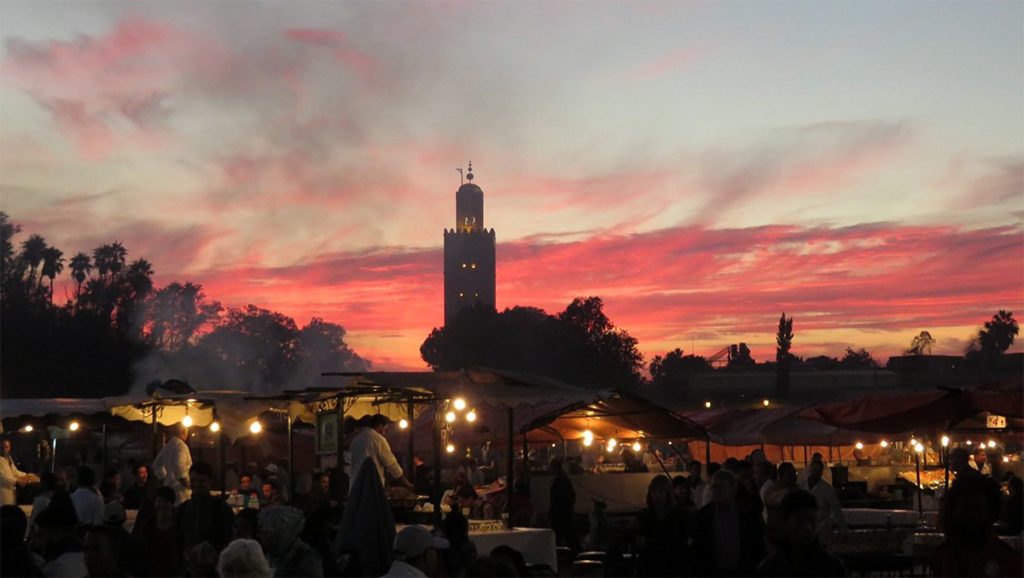
Jemaa el Fna is the central marketplace of the medina and the lively focal point of the old town. Once used as a market and execution site, it is now undoubtedly one of the highlights of any visit to Marrakech. If you’re looking to experience the Orient, this is where you’ll find yourself among performers, storytellers, and snake charmers—where tales from One Thousand and One Nights seem to come to life.
It’s a spectacle—a wild mix of smells, sounds, and food—that has been recognized as UNESCO Intangible Cultural Heritage since 2001 and is equally appreciated by locals and visitors.
The souks of Marrakech
The souks of Marrakech are undoubtedly the largest in Morocco and are world-famous for their exotic marketplaces. Especially for first-time visitors, the experience can feel confusing at first, yet equally fascinating. Within the maze of shaded alleys and sunlit passages, a world unfolds filled with colorful carpets, silk kaftans, fragrant spices, antique treasures, handcrafted lanterns, glazed ceramics, and sparkling jewelry.
The lively atmosphere, the hunt for bargains, and the art of bargaining itself draw travelers from all over the world. Historically, the souks were organized by the goods traded, with the most valuable items located at the center and less expensive goods towards the outer areas.
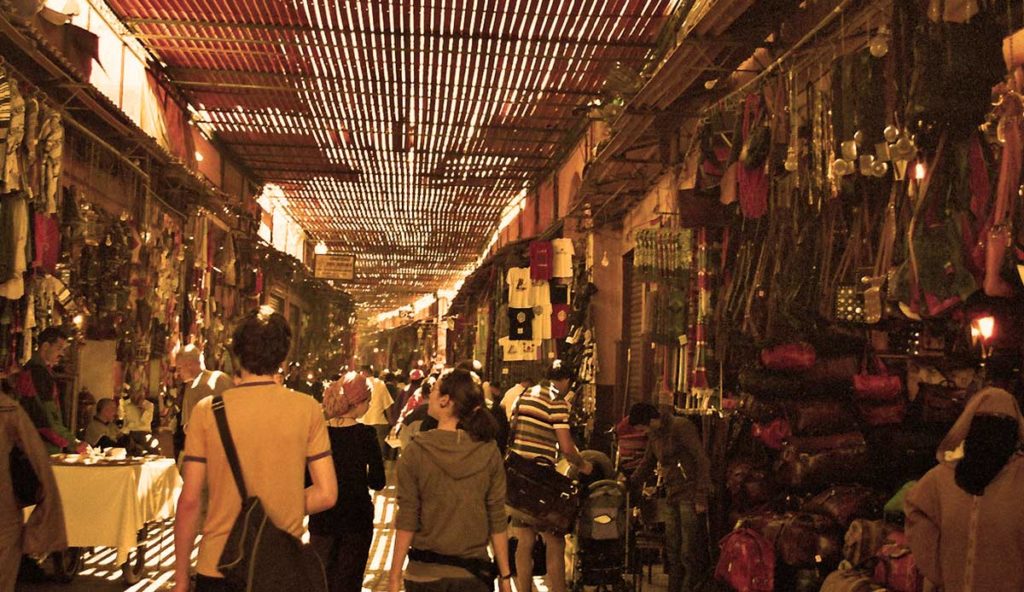
This tradition has endured over the centuries. Each souk still carries the name of the specific goods sold there. From Jemaa el Fna, the souks stretch north toward the Musée de Marrakech and extend south as far as the Bahia Palace.
Culinary Marrakech
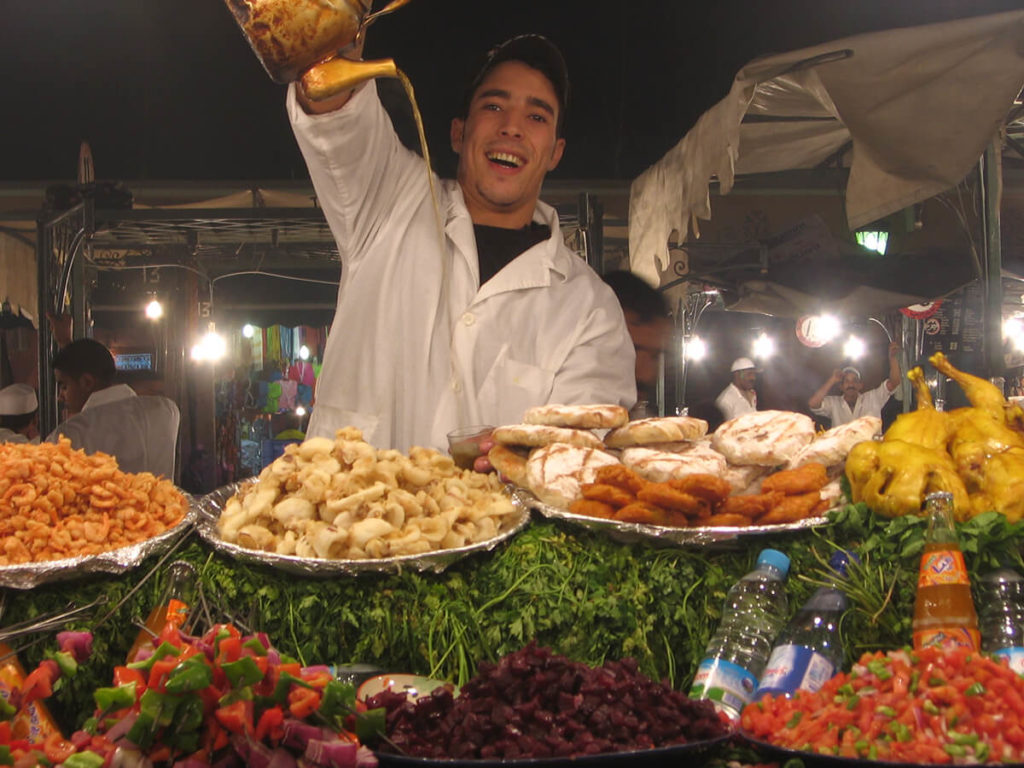
Beyond the famous food stalls on Jemaa el Fna, where a unique street food atmosphere emerges each evening, you’ll find numerous excellent restaurants tucked into the winding alleys, such as “Nomads,” along with small, family-run eateries. Here, you can sample not only traditional dishes like tajine, couscous, or harira, but also discover more unusual specialties.
Particularly typical is Marrakech’s mechoui—lamb slow-cooked in a clay oven. The street food scene also offers the more adventurous a chance to explore new flavors, ranging from snails to lamb brains. Freshly brewed mint tea is as much a part of daily life in the medina as bargaining in the markets.
Everyday life of the residents
Despite the growing number of riads and visible gentrification, many locals still live in relatively simple accommodations within the medina of Marrakech. Daily life often unfolds in the narrow streets and squares, as living spaces tend to be small and public areas play an important social role. In the souks, goods are not only sold but often produced on-site—workshop and shop frequently merge into one.
Alongside riads, small shops, barbers, mosques, schools, and traditional hammams shape the cityscape. The medina remains a place where visitors can experience authentic urban life in Morocco—with neighbors chatting in the streets, children playing in the alleys, and a rhythm of life that moves between tradition and modernity.
Major sights within the medina of Marrakech
Marrakech’s medina is defined by an exceptional density of historical and cultural landmarks that continue to shape the cityscape. Its most prominent landmark is the Koutoubia Mosque, with its 77-meter-high minaret, considered one of the finest examples of Moorish architecture and visible from almost anywhere in the city.
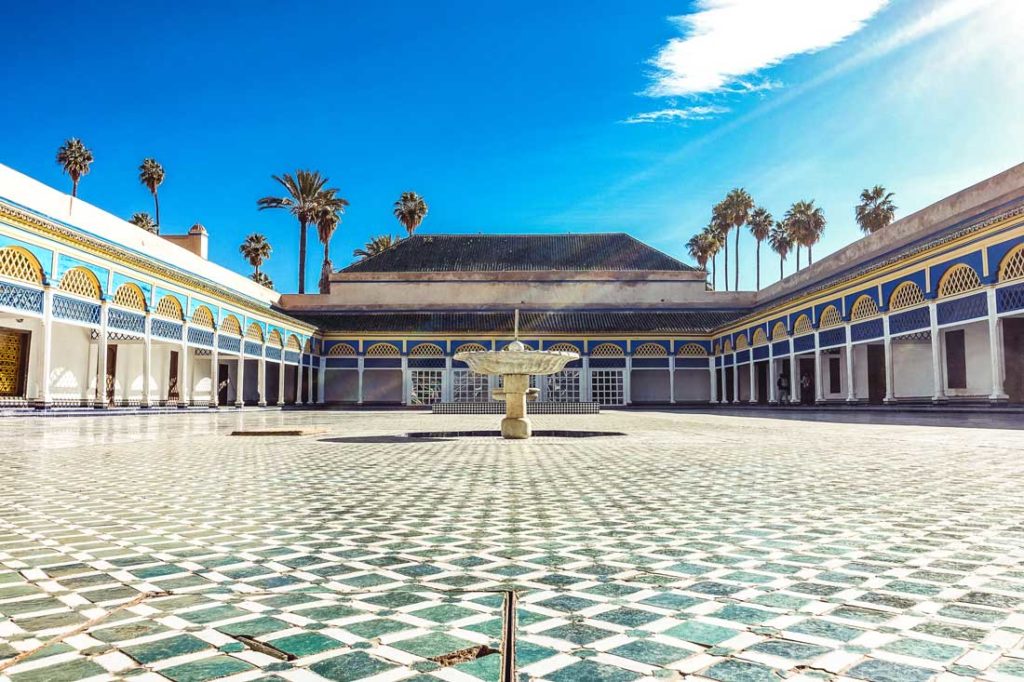
Close by lies the lively Jemaa el Fna, the central square of the old town. Further north, you’ll find the Ben Youssef Madrasa, one of the most important Quranic schools in North Africa, known for its intricate stucco work and peaceful inner courtyard. Nearby, the Bahia Palace reflects the splendor of Moroccan architecture with its ornate gardens and richly decorated halls.
Not far away are the Saadian Tombs, an elaborately decorated necropolis that stands as an impressive testament to royal history. In the adjacent Mellah, the former Jewish quarter, you’ll find several synagogues as well as the atmospheric Jewish cemetery, which is particularly worth a visit.
The Mouassine district in the northern medina is also worth highlighting, with its mosque of the same name, a traditional hammam, and several historic foundouks. These former caravanserais (inns) now often serve as workshops and trading spaces for local artisans.
If the pace of the medina becomes overwhelming, gardens such as Le Jardin Secret offer a green retreat. With its historic pavilions, it offers a calm oasis right in the city center.
Practical tips for visiting the medina
Orientation and getting around
Finding your way through the medina of Marrakech can be challenging. A helpful tip is to use the minarets of mosques as reference points—they rise above the rooftops and serve as natural landmarks. Keeping track of the cardinal directions also makes it easier to return to central areas.
The maze of alleys follows its own logic. Smaller lanes usually lead into even narrower passages and courtyards, while wider streets tend to connect to larger roads and eventually to the main routes of the medina. If you get lost, following streets that gradually widen will often lead you back toward the center or Jemaa el Fna.
Offline map apps such as OSMand can be useful, and friendly locals or young guides often help visitors find their way back to the square. Cars are not allowed inside the medina, so everything is explored on foot.
Behavior and etiquette
Bargaining in the souks is part of everyday life. There is no fixed “correct price”—what matters is that both sides are satisfied with the final deal. A good starting point is often around half of the seller’s initial asking price.
A friendly and relaxed attitude during negotiations goes a long way. If no agreement can be reached, it is perfectly acceptable to walk away politely. However, it is considered impolite to agree on a price and then not complete the purchase.
Safety
Marrakech is generally considered a safe city, including its busy medina. Many visitors report no issues with pickpocketing and feel comfortable even in the narrow alleys. Still, as in any tourist-heavy destination, it’s wise to keep an eye on your valuables and secure your belongings.
Vendors and shopkeepers will often approach you directly, which is simply part of the local market culture. A friendly smile and a polite “no, thank you” are usually enough to decline unwanted offers. If you behave respectfully and stay aware of your surroundings, you can explore the medina with ease.
Where to stay in the medina of Marrakech
If you want to experience Marrakech more deeply, staying in a riad is highly recommended. These traditional houses are built around an inner courtyard and are often lovingly restored. Most riads are located within the medina and offer a retreat from the busy streets, often with a rooftop terrace.
Staying in a riad means you’re right in the heart of the action, within walking distance of Marrakech’s main sights, while also experiencing authentic everyday life.
In addition to riads, the medina also offers simple hotels and hostels for travelers on a tighter budget. Along the edges of the old town, you’ll also find a few upscale hotels. But for a truly authentic Marrakech experience, a well-chosen riad in the heart of the medina is hard to beat.
| Riad | Info | Booking | |
|---|---|---|---|
| A lovely riad offering great value for money in the Mouassine district with its own pool |  |
||
| A small pool restaurant, roof terrace and bar serving alcoholic drinks |  |
||
| A luxury riad with a small pool to the north of Jemaa el Fna |  |
||
| An elegant riad in the Mouassine district with a pool and parking |  |
||
| A stunning luxury riad in the Mouassine district with parking, a spa, pool restaurant and bar |  |
| Riad | Info | Booking | |
|---|---|---|---|
| The perfect location with child care available and family rooms |  |
||
| Air-conditioned rooms with private terraces. Easily accessible |  |
||
| A cost-effective riad with a pool and family rooms |  |
||
| A lovely riad right on Jemaa el Fna with a restaurant, bar and family rooms |  |
||
| A pool, roof terrace, restaurant, private hammam and a great location |  |
||
| 'A fine riad in a fantastic location with its own pool. A 2015 booking.com award winner! |  |
||