
Sidi Ifni lies around 160 kilometers south of Agadir on Morocco’s Atlantic coast. With roughly 21,000 residents, it is significantly larger than neighboring Mirleft, yet it feels more remote. The town sits in a stark, desert-like landscape and marks the gateway to the Sahara. Large hotel resorts and mass tourism have never taken hold here. Instead, silence, sea air, and wide horizons define the atmosphere.
Architecturally, Sidi Ifni stands apart from most Moroccan coastal towns. Traces of the Spanish colonial period appear everywhere: fragments of old fortifications, Spanish street signs, and weathered Art Deco façades. This heritage also explains why Spanish is more present than French as a second language. The town center feels less like a typical Moroccan medina and more like a small southern European enclave with distinct Moroccan influences.
Daily life unfolds between the lighthouse and the buildings surrounding the main square. You will notice women wearing flowing malhafas, as well as the colorful, wide garments of the Sahrawi community. In local fabric shops, vendors demonstrate how these long cloths are wrapped and knotted. As you walk through town, you are more likely to meet fishermen and small craft workshops than large, tourist-oriented bazaars.
Contents
History of Sidi Ifni
Spanish presence in the region began in the 15th century with the establishment of the outpost of Santa Cruz de la Mar Pequeña. It served fishing and slave-trading purposes but was soon abandoned. The modern town, however, only took shape in 1934 under General Francisco Franco as a planned garrison and administrative center for Spanish West Africa.
The city center was designed on the drawing board in a distinct Art Deco style. Geometric lines and clean proportions still define the streetscape, even if many buildings now show signs of decay. Unlike the rest of Morocco, which gained independence in 1956, the region remained a Spanish province until 1969. After the Ifni War (1957–1958), Spain returned the enclave to Morocco on June 30, 1969. Since then, colonial architecture and the Spanish language have remained visible remnants of that era.


Sights in Sidi Ifni
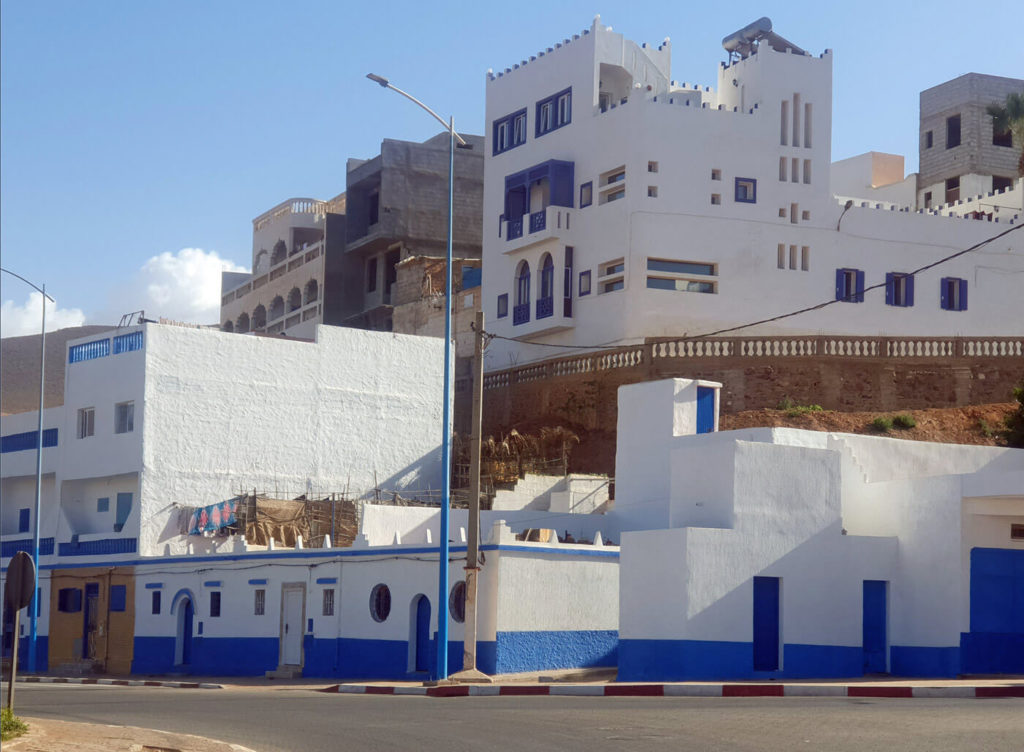
The architecture of the 1930s shapes the town’s character. Broad streets, pale administrative buildings, and a palm-lined main avenue create a surprisingly open layout. Most houses appear as white cubic structures with blue doors and shutters.
Notable landmarks include the former Admiralty, the Governor’s Palace, the Twist Club, and the former cathedral, which now houses the courthouse. Around the Spanish Square and Rue Sidi Mohammed, cubic façades blend with small gardens, reflecting the urban planning ideals of that period.

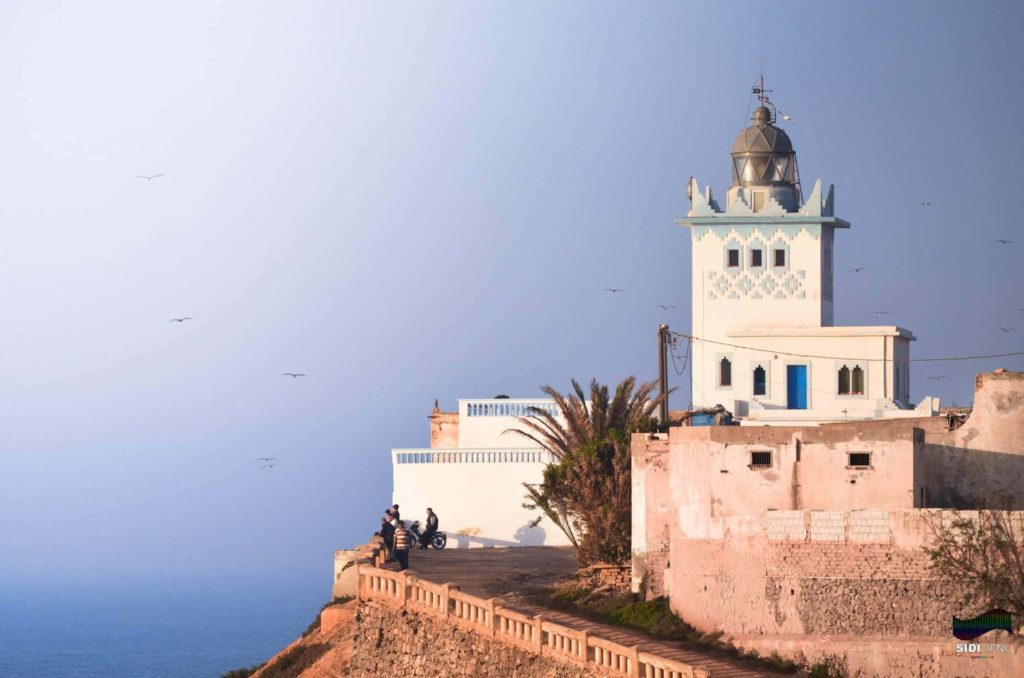
Lighthouse of Sidi Ifni
The white lighthouse from the colonial era stands on an elevation above the Atlantic and remains in operation today. It marks the end of the paved coastal paths and rewards visitors with sweeping views over the ocean and the dramatic cliffs below.

Harbor and Teleférico
On the southern edge of town, you will find the remains of the Teleférico cable system from the 1960s. Because the steep coastline made a deep-water harbor impossible, ships docked at a concrete platform. Goods and passengers were transported to land by cable car. Today, only the decaying concrete pylons remain, rising from the sea as stark industrial relics.

Weekly market
Every Sunday, a large market takes place on the former military airfield. Beneath canvas tarps, traders sell fruit, vegetables, spices, clothing, and jewelry. This souk serves the surrounding region primarily and reflects local demand rather than tourism. The atmosphere differs noticeably from that of the curated bazaars in Marrakech or Agadir, focusing instead on everyday trade.
Where to stay in Sidi Ifni
Accommodation in Sidi Ifni is concentrated around the beach and the historic town center. A popular option among travelers is Hotel Suerte Loca, a budget-friendly property by the sea featuring a restaurant, a spacious rooftop terrace, and balconies with ocean views. Along the coastline, you will find additional small hotels with direct beach access.
In the center, guesthouses such as Xanadu Guest House are set inside historic buildings. Most accommodations in the old quarter lie within walking distance of the main square and the key architectural sights, placing you right in the heart of the Art Deco district.
| Budget | |
| Ifni Surf Hostal | |
| Hotel Suerte Loca | |
| Mid-range | |
| Maison Xanadu | |
| Logis la Marine | |
| Holiday home | |
| Dar Yasmina | |
Campsites in Sidi Ifni
Most campsites in Sidi Ifni are located along the coastline below the cliffs. Facilities generally reflect Moroccan standards, with simple sanitary blocks and electricity hookups.
- Camping El Barco: This site sits along the seaside promenade beneath the cliffs. It offers marked pitches without shade. The sanitary facilities are located inside the adjacent hotel. The campsite remains open year-round.
- Camping Sidi Ifni: Centrally located behind a wall directly by the sea, this site provides spacious pitches, hot-water showers, and an on-site mechanic service. The grounds are guarded and lie about a two-minute walk from the beach.
- Camping Grancanaria: Close to the shoreline, this campsite accommodates around 50 motorhomes. The terrain is unpaved, without vegetation or marked plots. Facilities include washing machines, electricity connections, and sanitary blocks with hot-water showers. WiFi, fresh water, and waste disposal are included in the price. The town center can be reached on foot in approximately five minutes.
- Camping Tamhroucht: Located slightly outside the immediate center but near the weekly market, this site offers wind protection and basic sanitary facilities. Shade, however, is limited.
Activities
During the summer months, Sidi Ifni attracts surfers and kitesurfers as water temperatures rise and thermal winds intensify. The rocky coastline makes access to the water more challenging and requires experience. The conditions suit advanced riders, as the surf demands solid technical skills. Beginners usually head further south to the Dakhla lagoon, where conditions are more forgiving.

Excursion to Legzira
About ten kilometers north of Sidi Ifni lies Legzira Beach, known for its red sandstone arches. Since one of the large arches collapsed in 2016, a single major formation remains. A visit must be timed carefully with the tides, as the passages become inaccessible at high tide. Due to strong surf, swimming here is considered dangerous.
You can reach the beach by bus line 18 or by Grand Taxi. Alternatively, at low tide, an eleven-kilometer coastal hike connects Sidi Ifni with Legzira.

Excursion to Plage Blanche
Around 30 kilometers south of town begins Plage Blanche, Morocco’s longest sandy beach. Here, desert dunes meet the Atlantic directly. Due to its remote setting, visits are often combined with a 4×4 excursion.
Moussem Aknari (Caktus Festival)
Each August, the town celebrates the Moussem Aknari, also known as the Cactus Festival. Prickly pear cultivation covers approximately 50,000 hectares in the region and represents a key economic sector. The festival functions as a trade fair for local cooperatives showcasing fruit, seed oil, and cosmetic products.
The program includes live music, the traditional Baamrani dance, sports competitions, Fantasia equestrian performances featuring horses, and ceremonial gunpowder displays.
Weather and best time to visit
Sidi Ifni enjoys a mild climate year-round. Thanks to its Atlantic location, temperatures in July, August, and September remain lower than in Morocco’s inland regions. The main travel season for beach holidays runs from May to October. In winter and spring, water temperatures average around 17°C.
| Month | Water Temp. |
|---|---|
| Jan | 17,1 |
| Feb | 16,6 |
| Mar | 17,0 |
| Apr | 17,6 |
| May | 18,3 |
| Jun | 19,1 |
| Jul | 19,7 |
| Aug | 20,4 |
| Sep | 20,4 |
| Oct | 20,2 |
| Nov | 19,6 |
| Dec | 18,9 |
From December to February, rainfall is more frequent. During these months, nighttime temperatures can drop below 10°C, while daytime highs typically exceed 20°C. The cooler season is well-suited for hiking in the surrounding landscape.
| Month | Avg. High (°C) | Avg. Low (°C) | Rain (mm) | Rainy Days |
|---|---|---|---|---|
| Jan | 19 | 11 | 28 | 6 |
| Feb | 20 | 12 | 19 | 4 |
| Mar | 21 | 14 | 12 | 4 |
| Apr | 22 | 15 | 14 | 5 |
| May | 22 | 16 | 3 | 4 |
| Jun | 22 | 17 | 2 | 5 |
| Jul | 24 | 18 | 0 | 2 |
| Aug | 25 | 18 | 1 | 3 |
| Sep | 24 | 18 | 7 | 3 |
| Oct | 24 | 17 | 8 | 3 |
| Nov | 23 | 15 | 20 | 5 |
| Dec | 20 | 13 | 38 | 6 |
Getting to Sidi Ifni
The nearest international airport is in Agadir, approximately 160 to 180 kilometers from Sidi Ifni. By rental car, follow the N1 national road via Tiznit and Aglou. Driving time ranges from 2.5 to 3 hours.
For bus travel, the main departure point is Inezgane station, south of Agadir. Direct buses operated by CTM take between 3.5 and 4 hours. An alternative option is the Grand Taxi system. Shared taxis run from Agadir to Tiznit and, after changing vehicles, continue to Sidi Ifni. Each leg takes roughly one hour. Taxis depart once all seats are filled.
From Marrakech, the journey by bus or car takes around 8.5 hours. Within Sidi Ifni, most central sights are easily accessible on foot. For destinations outside town, such as Legzira Beach, local taxis and bus line 18 provide connections.