Anyone planning to explore Morocco independently without renting a car will quickly discover the railway system’s practicality. Morocco’s trains rank among the country’s most reliable forms of transportation. With frequent services and reasonably priced tickets, the rail network efficiently connects the main cities, requiring very little planning from travelers.
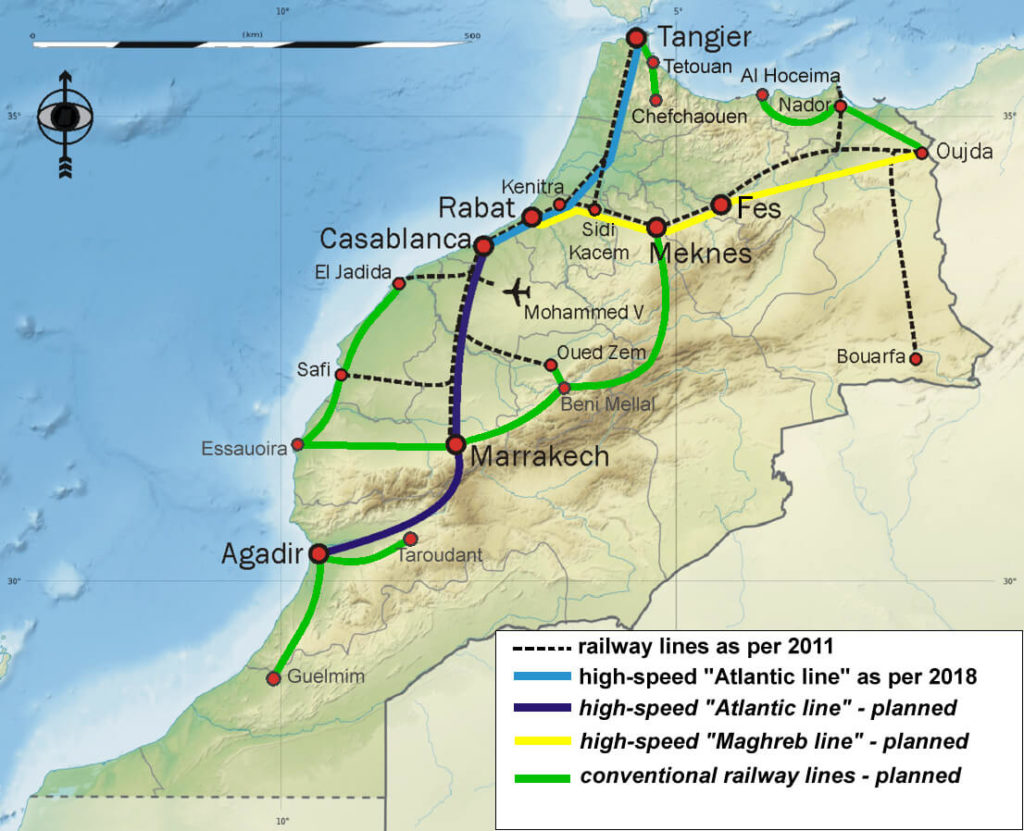
Morocco’s railway network follows clear geographic patterns. Most of the infrastructure is concentrated in the northwest of the country, linking Tangier, Rabat, Casablanca, Fès, Meknès, and Marrakech. Along these corridors, trains are often the fastest and most predictable way to travel. Reliable schedules and air-conditioned cars ensure a comfortable journey, even on longer routes across the country.
The national railway service ONCF operates both conventional long-distance trains and the high-speed Al Boraq trains. This line operates between Tangier, Kenitra, Rabat, and Casablanca, significantly reducing travel times along one of the country’s most important transport corridors. Apart from these main routes, however, the network quickly thins out. South of Marrakech and east of Fès, rail transport effectively ends.
Many railway stations also function as transport hubs. Long-distance buses, taxis, and often Supratours buses depart directly from the station or from nearby terminals. Transfers are usually straightforward, even for travelers unfamiliar with the city. For visitors without their own vehicle, this close integration between trains and buses is a major advantage.
Contents
The railway network in Morocco
In total, Morocco’s railway system covers roughly 3,600 kilometers and includes around 130 stations. But the rail map exposes a significant geographic divide in the country’s infrastructure.
The corridor stretching from Tangier through Rabat and Casablanca down to Marrakech is particularly well developed and serves as the backbone of the entire system. Within this zone, trains provide a reliable option for almost every travel distance, whether you are planning a short intercity trip or a longer journey across the country.
Outside this corridor, rail access becomes limited. Large areas of Morocco have no train connections at all. Regions such as the Atlas Mountains, the Sahara gateway cities, or parts of the southern Atlantic coastline are simply beyond the reach of the railway network.
As a result, trains work best when your itinerary includes Morocco’s major cities. For more remote destinations, buses or taxis will usually become the primary means of transport.
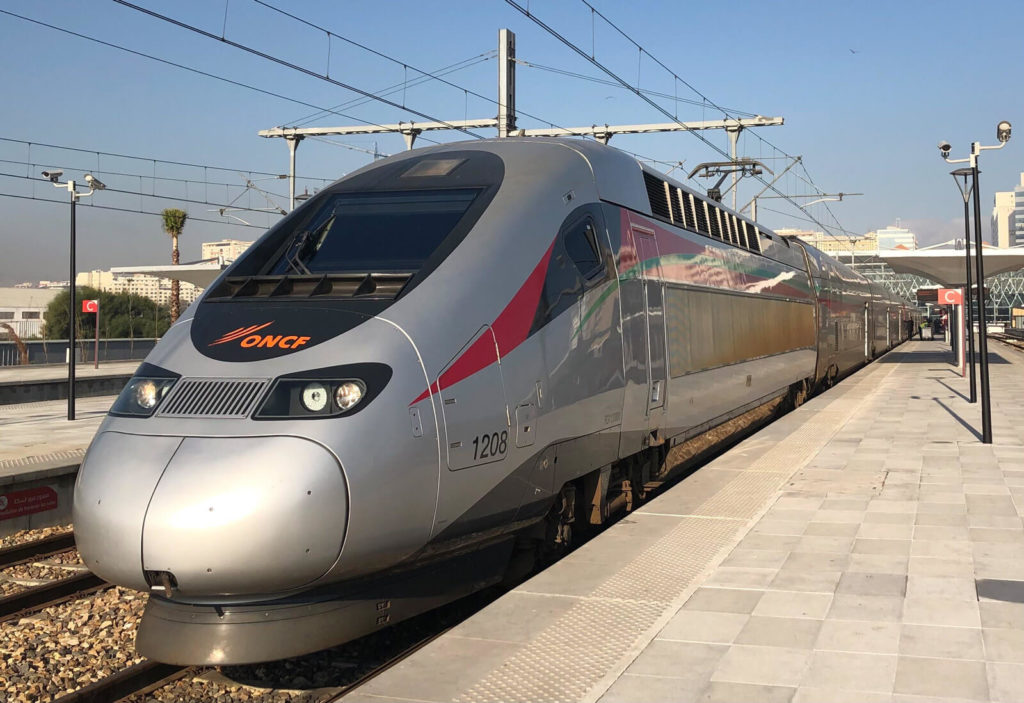
Al Boraq: Africa’s first high-speed train
With the introduction of the Al Boraq high-speed train in 2018, rail travel in northern Morocco changed significantly. Commuters, business travelers, and time-conscious tourists benefit from the rapid connections between Tangier, Kenitra, Rabat, and Casablanca, which slash long-distance travel time.
The train runs on its own dedicated line and reaches speeds of up to 320 km/h, reducing the journey between Casablanca and Tangier to around two hours.
Services operate frequently throughout the day and offer sufficient capacity even during peak travel times. Al Boraq utilizes European high-speed train designs, modified to ensure peak performance in the Moroccan climate.
The conventional long-distance trains
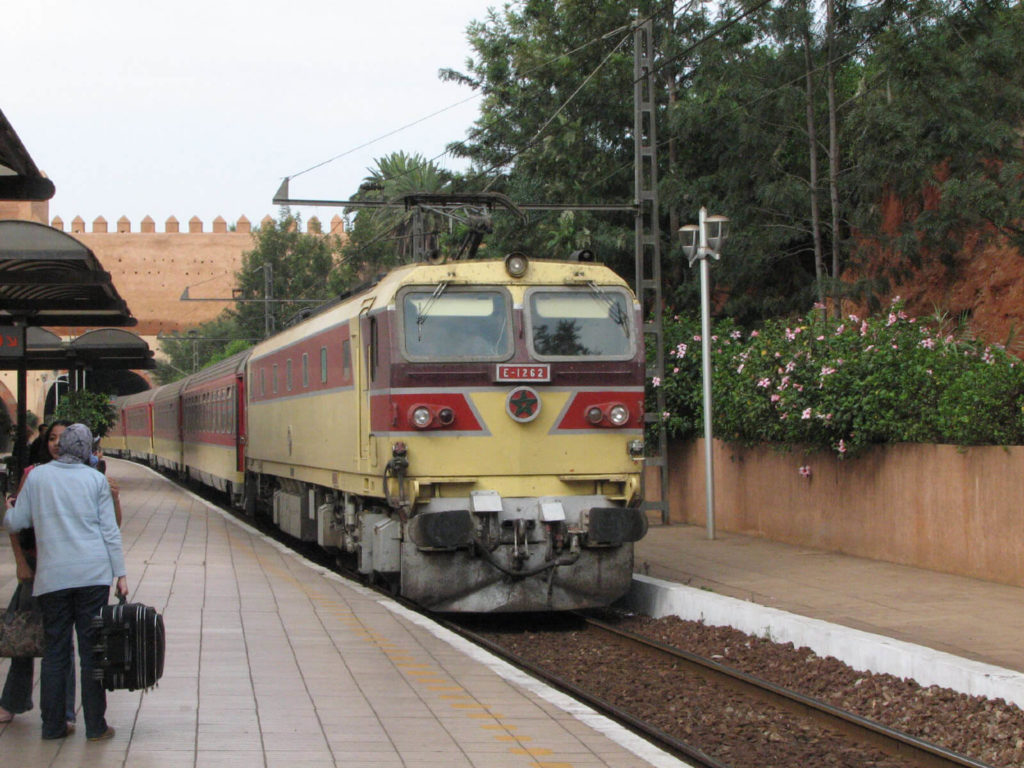
Beyond the high-speed corridor, the traditional long-distance rail network carries the majority of passenger traffic. These trains connect Casablanca with Marrakech, Fès, Meknès, and Oujda, and are particularly important for many tourist routes.
The line between Casablanca and Marrakech, in particular, is one of the most heavily used rail routes in the country.
While these trains do not reach high-speed levels, they still offer reliability, air-conditioned carriages, and moderate ticket prices. Regular departures allow for flexible travel planning.
Future plans include upgrading the line to Marrakech for high-speed travel. For current trips, however, this expansion is still years away.
Trains from Casablanca to Marrakech
The connection between Casablanca and Marrakech is often the starting point for many travelers experiencing Morocco’s railway system. The route covers roughly 130 kilometers and takes about 2.5 hours, with several departures throughout the day. This makes it easy to incorporate into most travel itineraries.
From Casablanca Airport, train connections are very frequent, although they require a transfer at Casablanca Oasis station. Depending on the timing of the connection, this may involve some additional waiting time.
Travelers who prefer a direct journey can alternatively take a taxi. This option is more expensive and usually offers little time advantage compared to the train.
The limits of the railway network
While the railway system functions well in northwestern Morocco, its limitations are equally clear. At present, the rail line effectively ends in Marrakech. From there, no tracks continue south toward Agadir or east toward the Atlas region.
As a result, many destinations in southern Morocco — including Agadir, Essaouira, or Ouarzazate — cannot be reached directly by train.
Morocco’s long-term plans envision extending the tracks to Agadir, but the route remains on paper for now. For current travel planning, however, it remains irrelevant.
What is practical, however, is that ONCF operates a well-coordinated bus network through Supratours that connects directly to the train system. On many routes, the train journey ends in Marrakech right next to the Supratours bus terminal, where the connecting bus is already waiting.
Combined tickets cover both segments of the trip, making the transfer smooth and allowing travelers to reach their destination easily, even without detailed planning.
Timetables, booking, and prices with ONCF
You can purchase train tickets in Morocco at ticket counters or self-service machines in railway stations. Prices are generally moderate, and both cash and common credit cards are usually accepted. While it is perfectly possible to buy tickets spontaneously, booking one or two days in advance can be advisable on busy routes, especially for first class and high-speed trains.
Online tickets are available through the ONCF website. Payment is made by credit card, although some travelers occasionally report difficulties with foreign cards. As an alternative, many hotels or local travel agencies will arrange ticket bookings for you in exchange for a small service fee.
In its timetables, ONCF distinguishes between faster connections such as Al Boraq and Atlas trains and slower regional services. The faster trains require seat reservations and are fully air-conditioned. Regional trains stop more frequently and are usually cheaper, but they offer less comfort.
In terms of pricing, train tickets typically fall within the same range as those offered by major long-distance bus companies, sometimes slightly cheaper. The surcharge for the high-speed train is roughly 30 %, but the significantly shorter travel times usually justify the higher price.
- ONCF Website
- Timetable (PDF-Version)
Popular routes and their prices
The following table provides an overview of typical routes and average ticket prices.
| Route | (1st/2nd Class) | Duration |
|---|---|
| Tangier – Marrakech | 390 / 225 DH | 5,5 h |
| Casablanca – Marrakech | 90 / 50 DH | 2,5 h |
| Casablanca – Fès | 90 / 70 DH | 4-5 h |
| Casablanca – El Jadida | 55 / 40 DH | 1,5 h |
| Casablanca – Rabat | 70 / 45 / 2 h |
| Marrakech – Fès | 350 / 260 DH | 7 h |
| Meknès – Fès | 30 / 25 DH | 0,5 h |
| Meknès – Tètouan* | 245 / 195 DH | 4,5 h |
| Rabat – Fès | 120 / 80 DH | 3 h |
What are trains in Morocco like?
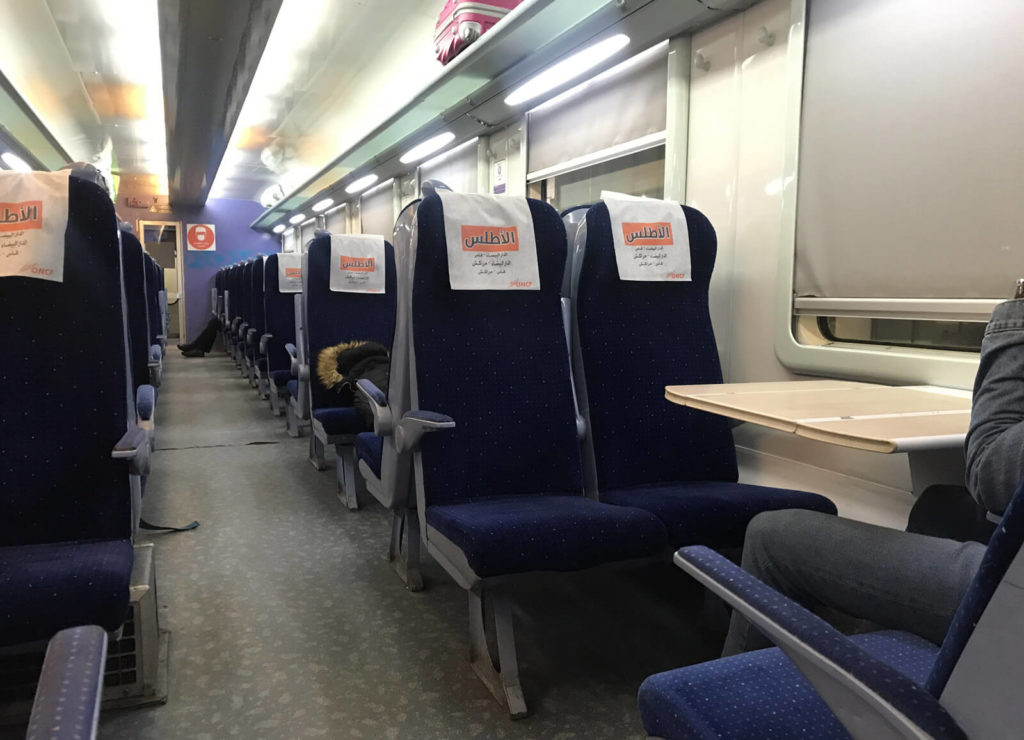
Overall, the condition of Morocco’s trains is good, though it varies by route. In the main corridors, modern long-distance trains and high-speed services, with reliable air conditioning and shorter travel times, represent a major improvement for passengers. On regional routes, the equipment is more basic but remains functional.
Traveling is safe in both classes. First class offers reserved seats and slightly more space, either in smaller compartments or in more spacious open-plan carriages. In second class, seats are not assignable, which can occasionally lead to crowded conditions when trains are busy.
The price difference between the two classes is relatively small, which is why first class often makes sense for longer journeys. Travel times remain the same regardless of the class you choose — both classes arrive at the destination at the same time.
Contrary to some older reports, night trains with sleeping or couchette cars no longer operate on the north–south axis between Tangier and Marrakech. All services on this route now run during the daytime.
Practical tips for train travel in Morocco
On longer journeys, it is advisable to bring your own drinks and snacks. During Ramadan in particular, the onboard catering service may be limited or unavailable. But even outside this period, there is no guarantee of food service on every connection.
Announcements on the trains are not always easy to understand, and are usually in Arabic and French. It helps to know the approximate arrival time or to check the route briefly beforehand. A simple map app is often enough to track your progress along the line.
At major stations, especially in tourist cities, self-appointed helpers or guides sometimes approach arriving passengers. They may offer assistance with finding transport or accommodation, but will usually expect payment in return. If you prefer not to use such services, a polite refusal is sufficient — official taxis are typically waiting directly outside the station.